If you are using NextLevelBot or any TradingView automation tool to place trades in your demat account, you might have recently noticed a serious issue — alerts are triggering, but orders are not getting executed.
This is not a bug, and it’s not limited to one platform.
With new guidelines introduced by Securities and Exchange Board of India, the way TradingView bridge systems interact with brokers like Zerodha, AngelOne, and Upstox has fundamentally changed.
In this blog, we’ll break down:
- Why NextLevelBot users are facing execution issues
- What has changed in TradingView to demat account automation
- And which TradingView bridge actually works reliably in India
What Is a TradingView Bridge?
A TradingView bridge is a system that connects TradingView alerts to your broker account, allowing automated execution of trades.
The basic flow looks like this:
- TradingView alert is triggered
- A webhook is sent to a bridge
- The bridge places an order in your demat account
This is how most platforms, including NextLevelBot, operate.
However, this simple workflow worked well earlier — but recent regulatory changes have introduced new requirements.
What Changed for TradingView Automation in India?
As per updated guidelines from SEBI, API-based trading now requires orders to originate from a whitelisted static IP address.
This means:
- Every trading system must use a fixed static IP
- That IP must be registered with your broker
- Orders coming from unknown or dynamic IPs can be rejected silently
This directly impacts all TradingView bridge systems that rely on generic or shared infrastructure.
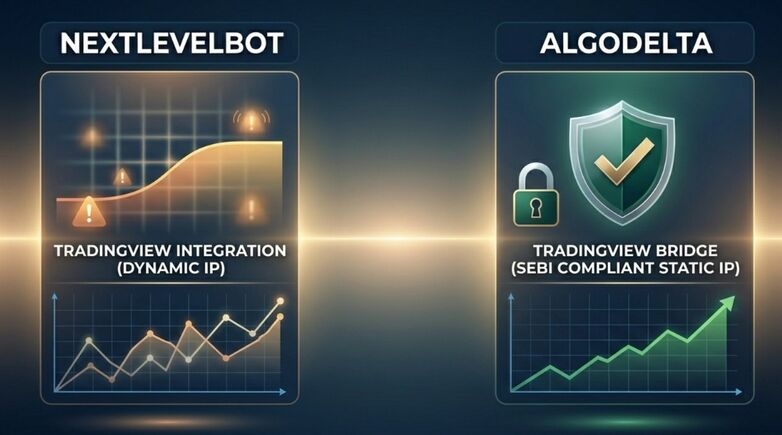
Why NextLevelBot Is Not Executing Trades
NextLevelBot works as a webhook-based TradingView bridge. It forwards signals from TradingView to your broker.
While this approach worked earlier, it now faces limitations:
- No dedicated static IP per user
- No broker-level IP whitelisting
- No infrastructure layer to meet compliance requirements
As a result, many users are facing:
- TradingView alerts triggering but no order execution
- Random failures in trade placement
- No clear error messages from brokers
This is why searches like “NextLevelBot not working” and “TradingView webhook not executing trades” are increasing.
TradingView Bridge for Demat Accounts: What Is Required Now
To reliably connect TradingView to a demat account in India today, a bridge must provide:
- A dedicated static IP
- Broker integration with IP whitelisting
- Stable execution infrastructure
- Ability to manage trade logic (SL, target, etc.)
Without these, even if your TradingView strategy is perfect, execution will fail.
How AlgoDelta Solves This Problem
AlgoDelta is built specifically for Indian markets and addresses these exact challenges.
Instead of acting as just a webhook forwarder, it provides a complete TradingView bridge with execution infrastructure.
Key capabilities include:
- Static IP creation for each user (SEBI compliant)
- Direct integration with demat brokers
- Reliable order execution from whitelisted IP
- Built-in stop loss and target management
- Ability to trade options using index signals (ATM selection)
- Multi-account execution from a single strategy
- Paper trading support for testing
This makes it a fully compliant TradingView to demat account bridge, not just an automation tool.
NextLevelBot vs AlgoDelta: Key Differences
| Feature | NextLevelBot | AlgoDelta |
|---|---|---|
| TradingView Bridge | ✅ | ✅ |
| Static IP (Required by SEBI) | ❌ | ✅ |
| Order Execution Reliability | ⚠️ Limited | ✅ Stable |
| SL / Target Engine | ❌ | ✅ |
| Index to Options Automation | ❌ | ✅ |
| Multi-Account Execution | ❌ | ✅ |
| Paper Trading | ✅ | ✅ |
Which TradingView Bridge Should You Use?
If your goal is simply to forward signals, tools like NextLevelBot may still work in limited cases.
However, if you want:
- Reliable execution
- Compliance with Indian regulations
- Ability to scale across accounts
- Advanced automation (SL, options, etc.)
Then you need a TradingView bridge that includes infrastructure, not just signal forwarding.
Conclusion
The landscape of automated trading in India has changed.
Earlier, a simple webhook bridge was enough.
Today, execution requires compliance, infrastructure, and stability.
If your TradingView alerts are not converting into trades, the issue is not your strategy — it’s the system executing it.
Choosing the right TradingView bridge for your demat account is now more important than ever.
FAQ
Why is NextLevelBot not executing trades?
Because it does not provide a static IP required for broker-level compliance, leading to order rejections.
Is static IP required for TradingView automation in India?
Yes, as per SEBI guidelines, API-based trading requires orders to originate from a whitelisted static IP.
How to connect TradingView to a demat account properly?
You need a TradingView bridge that provides static IP, broker integration, and stable execution infrastructure.
What is the best TradingView bridge for Indian brokers?
A platform that offers static IP, execution reliability, and integration with brokers like Zerodha and AngelOne is ideal.