
Automating trades directly from TradingView to a demat account has become increasingly popular among traders in India. With strategies running on charts and alerts triggering in real time, the idea of seamless execution sounds simple.
However, many users — especially those using platforms like NextLevelBot — are now facing a common issue:
👉 TradingView alerts are triggering, but trades are not getting executed.
This is not a strategy problem.
This is not even a platform bug.
It’s a shift in how TradingView bridge systems must operate in India today.
What Is a TradingView Bridge?
A TradingView bridge is a system that connects TradingView alerts to your broker account, enabling automated trading.
The process typically works like this:
- A strategy runs on TradingView
- An alert is triggered
- A webhook sends the signal to a bridge
- The bridge places an order in your demat account
This setup is widely used for:
- Intraday trading
- Options trading (NIFTY / BANKNIFTY)
- Algorithmic strategies
The Growing Demand for TradingView to Demat Account Automation
Indian traders are increasingly looking for:
- TradingView to Zerodha bridge
- TradingView to AngelOne automation
- TradingView to Upstox API integration
This demand is driven by:
- Simplicity of TradingView strategies
- Speed of execution
- Ability to automate decisions
However, as adoption grows, so do execution challenges.
Why TradingView Bridge Is Not Working for Many Users
Recently, a large number of traders have reported:
- Alerts triggered but no order placed
- Webhook working but execution failing
- Inconsistent or delayed trade placement
These issues are especially common among users relying on simple webhook-based tools.
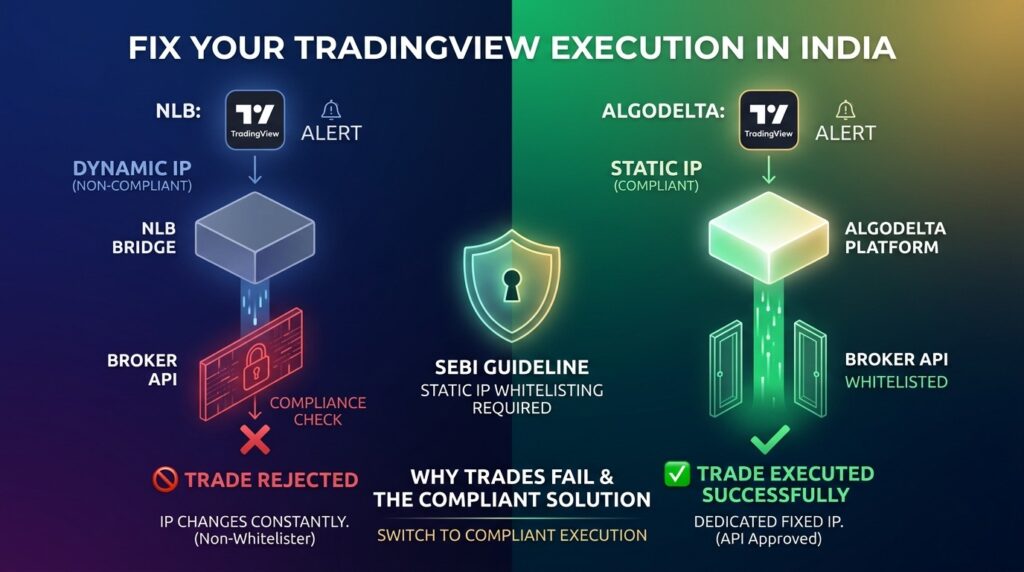
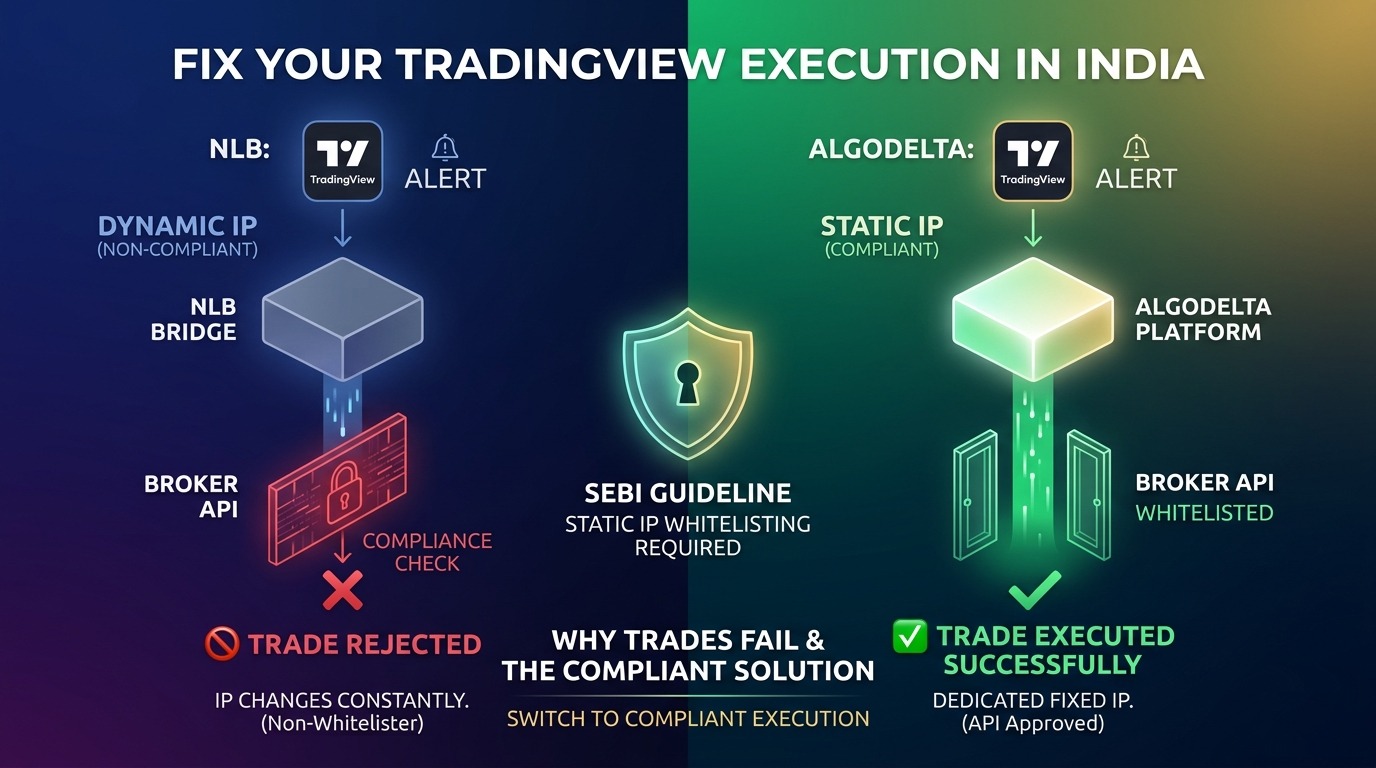
The Real Reason: Regulatory Changes in India
The root cause lies in updated requirements from Securities and Exchange Board of India.
Under new guidelines:
👉 All API-based order execution must originate from a whitelisted static IP address
This means:
- Each user must have a dedicated static IP
- That IP must be registered with the broker
- Orders from unknown IPs may be rejected or ignored
Why NextLevelBot Users Are Facing Issues
Platforms like NextLevelBot operate as basic TradingView bridges.
They:
- Receive webhook signals
- Forward them to the broker
But they do not provide:
- Dedicated static IP per user
- Broker-side IP whitelisting
- Execution infrastructure required for compliance
Because of this, users experience:
- Failed order execution
- Silent rejections
- Unreliable automation
TradingView Bridge in India: What Actually Works Now
To successfully automate trades from TradingView to a demat account in India, a system must provide:
1. Static IP Infrastructure
- Fixed IP address per user
- Required for broker compliance
2. Broker Integration
- Direct connection with brokers
- Proper API handling
3. Execution Stability
- Orders placed reliably
- Minimal failure rate
4. Trade Management Layer
- Stop loss and target automation
- Ability to manage open positions
👉 Without these, a TradingView bridge is incomplete.
A Smarter Approach to TradingView Automation
AlgoDelta addresses these challenges by providing a complete TradingView bridge built for Indian markets.
Instead of just forwarding signals, it offers:
- Static IP generation for compliance
- Seamless connection to demat accounts
- Reliable order execution
- Built-in stop loss and target logic
- Ability to trade options using index signals (ATM selection)
- Multi-account execution from a single strategy
- Paper trading for testing
Why Execution Matters More Than Strategy
Many traders focus only on strategy performance.
But in real trading:
👉 Execution is equally important
Even a profitable strategy can fail if:
- Orders are not placed
- Execution is delayed
- Trades are rejected
This is why choosing the right TradingView bridge is critical.
Who Needs a Proper TradingView Bridge?
You should consider a robust solution if you:
- Trade options using TradingView
- Run automated strategies
- Use multiple demat accounts
- Want consistent and reliable execution
- Are serious about algo trading in India
Conclusion
TradingView automation in India is evolving.
Earlier, a simple webhook bridge was enough.
Today, execution requires compliance, infrastructure, and reliability.
If your TradingView alerts are not converting into trades, the problem is not your setup — it’s the system executing those trades.
Choosing the right TradingView bridge for your demat account is now a necessity, not an option.
FAQ
What is a TradingView bridge?
A system that connects TradingView alerts to a broker account for automated trade execution.
Why is TradingView not placing orders?
Because the bridge being used may not meet new compliance requirements like static IP and broker whitelisting.
Is static IP required for TradingView automation in India?
Yes, as per SEBI guidelines, automated trading systems must use a whitelisted static IP.
How to connect TradingView to demat account in India?
Use a TradingView bridge that provides static IP, broker integration, and reliable execution infrastructure